

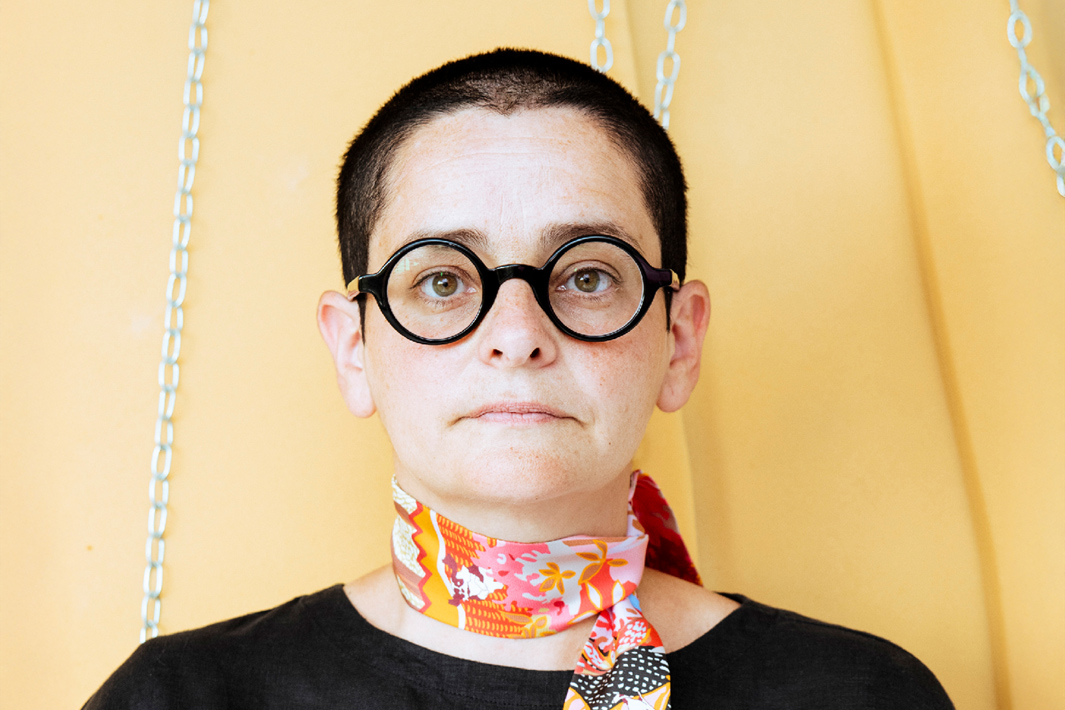
As part of Girbau LAB’s Neighbourhood Interview Series, we talk to Mireia Luzárraga, Architect and co-founder of TAKK, about an approach to architecture that goes far beyond designing walls.
With Mireia, we explore water management not only as a resource, but also as a symbolic material and source of life; the challenge to domestic individualism through everyday acts such as doing the laundry; coexistence not only with our neighbours, but also with other species; and the future challenges involved in transforming cities into fairer, more caring and more sustainable spaces.
Listen the original interview
What is your relationship with doing laundry in your day-to-day life?
I have to answer in two parts because I live between Barcelona and New York. In Barcelona, we live in an industrial space in L’Hospitalet and we don’t have a washing machine. We use the local laundromats in the street, and we’re very happy to use this say private but public space. In New York, on the other hand, the laundromat is in the basement of the building, which is very common there. I find it really interesting to reflect on which parts of the house can become more public. The moment you can make a fragment of domestic life more public, that’s when you start having a different relationship with your neighbors. When you leave your own building, you’re forced to share space and a considerable amount of time with people from different backgrounds, and having those types of experiences on a social level is very interesting to me.
How do you understand architecture in relation to water – not just as a resource, but as a material, a symbolic space, and a source of life?
The starting point for Water Parlaments, the exhibition we did with Eva Franch for the Catalan Pavillion in Venice came from this: not looking at water purely as a resource, but as something that mediates among many actors. Every time we build something that alters the flow of water, we modify ecosystems. In Columbia, we work with students on what we call the metabolic section to explain how an architectural process is connected to many networks. One of the examples I give them is: “What relationship does your washing machine have with a whale?”. You put a sweater in the washing machine, it connects to the sewage system, empties into the ocean, and the sweater releases microfibers that the whale ingests, affecting its fertility. We are in a crisis of representation, and we feel it’s important to be able to represent the consequences of our designs so we can design in a fairer and more efficient way.
What lines of research or experimentation are you pursuing to keep innovating in the relationship between architecture and water?
With Water Parlaments, we experimented from a more speculative point of view. Since architects have limited knowledge, we set up “future laboratories” across Catalonia, Valencia and the Balearic Islands bringing together 25% activists, 25% scientists, 25% engineers, and 25% artists to talk about water. These were very special sessions with people who had never sat at the same table before and were in some cases publicly at odds (farmers, desalination engineers, environmentalists…). From architecture we can bring creativity and design projects, speculative architectures, but these issues must be tackled in a multidisciplinary way.
How do you think architecture and shared services impact the pace of daily life and the concept of time?
Engaging in activities that force you to slow down is very transformative nowadays. In a society that talks about modifying sleep to perform better, the moment of doing laundry forces you to stop and do something non-productive. Furthermore, questioning domestic space and moving certain activities into the collective sphere can build community and sustain care work. Creating shared spaces with people of different incomes and cultures can make us more empathetic, solidary, and collectively aware. By changing the design of the home, we can change people’s ways of living: in some countries individual bedrooms emerged with early capitalism to foster individual desires and individualism; in our projects, we experiment with questioning which individual activities could cease to be so.
How do you understand neighborhood when including other species like animals, plants, or microbes?
We are living through climate change and the sixth mass extinction, yet we don’t think about it enough from the perspective of cities and homes. In 2022, we were commissioned to rethink coexistence with other species in Barcelona. We analyzed the plant species palette in public spaces – which used to be selected solely for aesthetics or allergies – and proposed new species based on climate change resilience, CO₂ absorption, or attracting pollinators. Inside homes, incorporating vegetation helps regulate temperature in a mutualistic way. We need to understand that fungi and microorganisms live in our walls, and we should seek alliances with the species that coexist with us, of course keeping health standards.
How do you see the transition from exhibition work to reality, and how does your work contribute to transforming it?
Through our work in cultural institutions, we gain a voice within the discipline of architecture. By stating publicly that the modern typology of hallways and individual rooms relies on fossil fuels and needs new models, the debate reaches the media. An exhibition creates a space where the public internalizes these ideas, and eventually laws or landscapes transform. It is vital to stay connected with collectives and activism to create a social imaginary that makes it possible.
Looking ahead 25 years (to 2050), how do you imagine neighboring and daily life in Barcelona?
I would like it to be a city that stops prioritizing the most privileged, that sustains care work, and that is more solidary, fairer to marginalized minorities and other species, and much less dependent on cars and oil. I would like it to be the “City of Care.” Every time I visit, I see Barcelona becoming more challenging in terms of housing due to speculation, but I also see more and more collectives are working on it. Hopefully, things go well and we move toward this more community-minded model.
share