

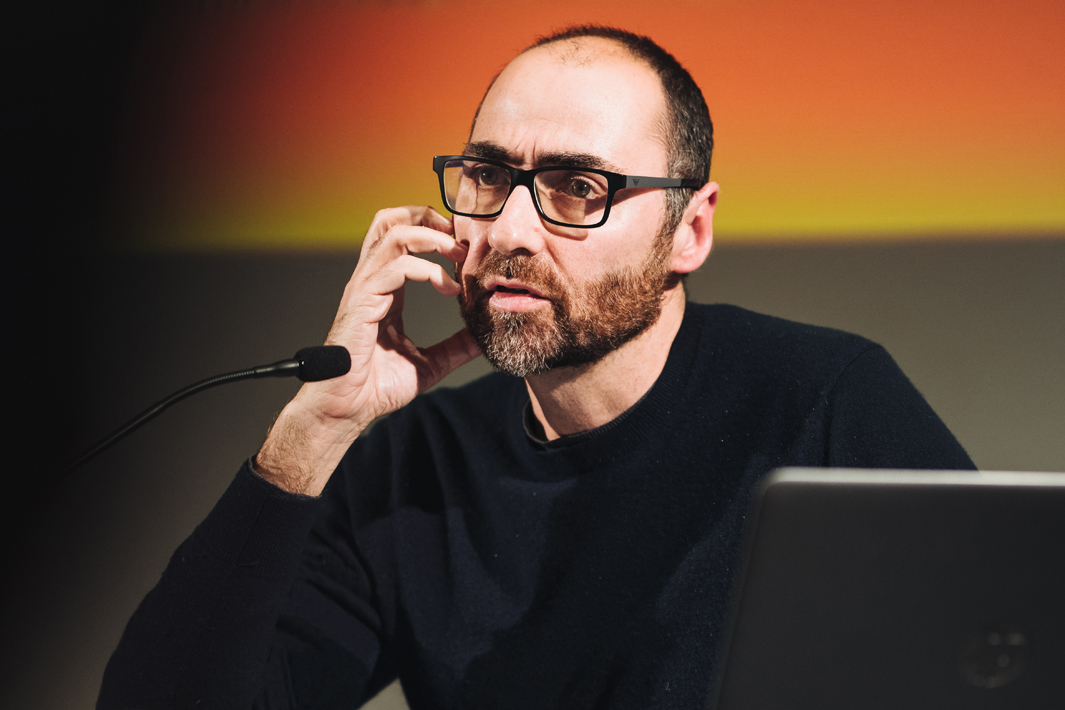
Talking with Ferran Grau Valldosera is an opportunity to explore the connection between education, critical thinking, and professional practice through what he calls prior domesticity: all the conditions that allow us to feel at home within our neighborhood before we even step into our own homes. An architect, PhD, and professor of architectural design and urban planning at the ETSA URV, he is co-director of the journal Quaderns d’Arquitectura i Urbanisme (issue 272) and co-founder, together with Nuria Casais, of GrauCasais Architects.
As part of the Neighbourhood interview series by Girbau LAB, this conversation with Ferran explores how architecture is being conceived today, how we are educating future generations of architects, and which values are emerging in the practices of young professionals when designing collective spaces and the infrastructures that shape everyday life.
Listen the original interview
We begin the interview by exploring one of your roles: your work as a professor at the Reus School of Architecture. In your day-to-day work with students, is design approached with shared spaces and services in mind, or are we still focused on the traditional housing program?
Thank you for inviting me to the Neighborhood Interview Series. At the Reus School of Architecture, we have a very particular feature, which is that we teach urban planning and architectural design together. This means that we do not think in terms of isolated architectural objects, but rather connect the architecture of community, collective, and public space with the territory.
In the third year, within the architectural design studio, we work on collective housing. There, we explore the cooperative model and the different forms of community-based residential housing in depth. For us, it is essential to teach students to design the city and architecture from the premise that, above all, they are designing the conditions for creating community.
Historically, domestic infrastructures such as laundry have been treated as secondary elements, or even hidden altogether, in social housing projects. Do you think this sensitivity is changing?
Laundry has undergone an important change linked to sanitation and new improvements in the reuse of greywater. Traditionally, the washing machine has occupied an in-between position between the kitchen and the laundry room, and it has not always been easy to incorporate it with dignity.
There has also always been a certain cultural taboo around hanging clothes out to dry: there has been a tendency to hide or cover them. But design is evolving. We are now seeing projects that place these functions in much more dignified spaces, directly taking advantage, for example, of building rooftops as well-resolved meeting places.
And what habits or difficulties do students encounter when addressing this transition between the private sphere and community services within the building?
We always ask students to produce an urban and territorial drawing that clearly shows the boundary between the public and the private. We do this first during the analysis phase of the existing situation and, later, in the project proposal.
This exercise clearly reveals how this dividing line is changing. Ideally, the common space should appear — precisely that intermediate zone between the street and the home. This is something that cooperative teams here in Catalonia, among other professionals, have developed extensively: the idea of a public or private space that is managed or lived collectively. It is positive for these boundaries to become blurred. The only point where we must remain very alert is to avoid a classic urban problem: the private sector appropriating an investment made by the public administration for the benefit of the community.
In your research career, you have spent time at international centers, for example in Switzerland. Are there cultural differences in how other countries manage this shift toward the communal?
Yes, the experience in Switzerland, for example, was very interesting. There, the physical line between public and private space in the city practically does not exist; you can approach the edge of a house and you will not find fences, although the landscape and the code change.
As for laundry management, in the housing where I was staying, the laundry room was entirely communal. It was located in a well-ventilated semi-basement, connected to a courtyard, and self-managed by the neighbors themselves. This is a purely cultural reality; just as ecological awareness is. There, I saw a recycling system that had been structured for years; students there have internalized it so fully that they naturally incorporate it into their projects from day one.
What are the values and voices that move younger architects today? What is their commitment?
In this new generation, there is a very powerful conceptual shift in the way teams and cooperatives work: they engage in much more collaborative work than we did. Community awareness is already born within the university classroom itself.
They have also fully integrated concern for climate change. Their focus at university is on applying passive environmental control systems and integrating them into the essence of architecture. Awareness around resources and the reuse of materials — the well-known idea of circularity — is also emerging strongly. Although in Barcelona this process of circular construction is only beginning and still needs to be further implemented in the classroom, young people are already fully aware of it.
This surely creates a tension that I would like to explore. Young people leave university with this community-oriented and regenerative outlook because the education they receive guides them toward these values, but in many cases they come up against professional practices and a real estate market that does not necessarily value them. How is this mismatch managed?
Reality surpasses fiction in many cases. In fact, it is important to remember that much of the new wave of young architects in Catalonia, who are leading the transformation in this collective domesticity, emerged precisely as the profession’s response to a period of severe economic crisis after 2008.
I believe that a very broad field of work is now opening up: the need to build much more housing in Catalonia is being raised, and this will force us to review many architectural and regulatory archetypes. Even in the worst moments, architects have an obligation to reassess themselves. I want to be optimistic in this sense, without ever overlooking the fact that the reality of the market is very tough.
In your projects, such as the Àtria Residence or the Warehouse Dwelling, you have explored precisely the limits of what is shared. What dilemmas arise when breaking away from our individual habits?
The Àtria Residence is the first center in Catalonia designed specifically for adolescents and young people with intellectual disabilities. The main challenge of the project was to succeed in building a real “home.” And for us, making a home meant carefully designing the common spaces: the courtyard, the swimming pool, the dining room, and the living rooms. In a residential setting, the value of dwelling lies precisely in its collective character and in how the building connects with its immediate surroundings. The pre-established archetype had to be changed.
In the case of the Warehouse Dwelling, the starting point is different: it is a small building designed to take care of a piece of land in the Camp de Tarragona. There, there is no more generous act in the design than the fact that the main room is, in reality, the kitchen and fireplace, with a bed that simply folds out when needed. Spatial priority is given to the place where people gather at the weekend to work the land and share a meal. The collective spirit is what structures the entire floor plan.
In the Neighborhood Interview Series project, we talk a lot about “good neighborliness.” Sometimes, when design tries to impose socialization too rigidly, spontaneity is lost. What ingredients do you think architecture needs for neighborliness to emerge in a natural and human way?
For years, I have been thinking about a concept I call “prior domesticity.” It consists of designing shared spaces, and the home itself, before they are inhabited, with conditions of comfort; that is, thinking — for example — about entrance halls or communal areas so that they have natural light, good ventilation, and corners where people genuinely want to spend time, beyond the doors of their own homes.
It is a very simple principle: if you provide these transitional spaces with high-quality environmental conditions, people end up opening themselves to dialogue spontaneously and making the spaces their own. There are recent examples of social housing in Catalonia where this phenomenon is clearly visible.
What are the principles of this new sensitivity in social housing being developed in our context?
It is about expanding the section of communal and circulation spaces for things as simple as being able to place a table, a chair, or some plants there. It means giving more dimension to the intermediate space. This, of course, also requires co-responsibility and care on the part of the neighbors, because common areas must be managed and looked after by mutual agreement.
The pandemic and other factors have made it clear that housing regulations, which established very tight surfaces and spaces, need to be revised. Architecture must move forward in parallel with our new social needs.
Now I would like to explore your role as co-director of urban planning and architecture magazines. This keeps you connected to the contemporary culture of the profession in a special way. How do you view this attention to the shared management of resources and collective architecture? Is it a trend or a consolidated paradigm shift?
Theory is indispensable because it allows us to reflect on what we do, but if we look at the current Catalan context, we can see that we are producing a great deal of theory directly through practice. It is a pure necessity.
In Catalonia, many studios show a very high level of technical and social commitment. Historically, there have been utopian theories, but right now we are working with theories of the present, very close to material reality. Very diverse models of dwelling are beginning to consolidate, and more will come; our task is to theorize about these real works in order to learn how we can continue responding to society’s new demands, which are very different from those of ten or fifteen years ago.
And what are the major trends or factors of change that will shape the coming years?
The determining factor will be recircularity. It is still not widely implemented because the process is economically very costly, but the need to transform and regenerate existing buildings — whatever their use may be — in order to convert them into housing will be a constant. We must make the architectural program more flexible in order to respond to fast-changing ways of life.
And if we look at the future of education twenty years from now, how should architecture be taught in an increasingly digitized world mediated by Artificial Intelligence?
This is a complex question that concerns many of us. In a context where it seems that all knowledge is rapidly diluted through networks or can be delegated to automated processes, I believe that, for the future of the discipline, it will be more important than ever not to lose the craft of knowing how to draw buildings very well, as a way of thinking through making and understanding what already exists.
And, above all, we cannot lose the constructive dimension, the knowledge of how things are materially built. Fortunately, in our cultural fabric, the value of detail and good construction is once again highly appreciated, and that is excellent news. The architecture of the future will require dialogue, mutual involvement, and great care in materiality in order to continue being a real and solid service for citizens.
share