

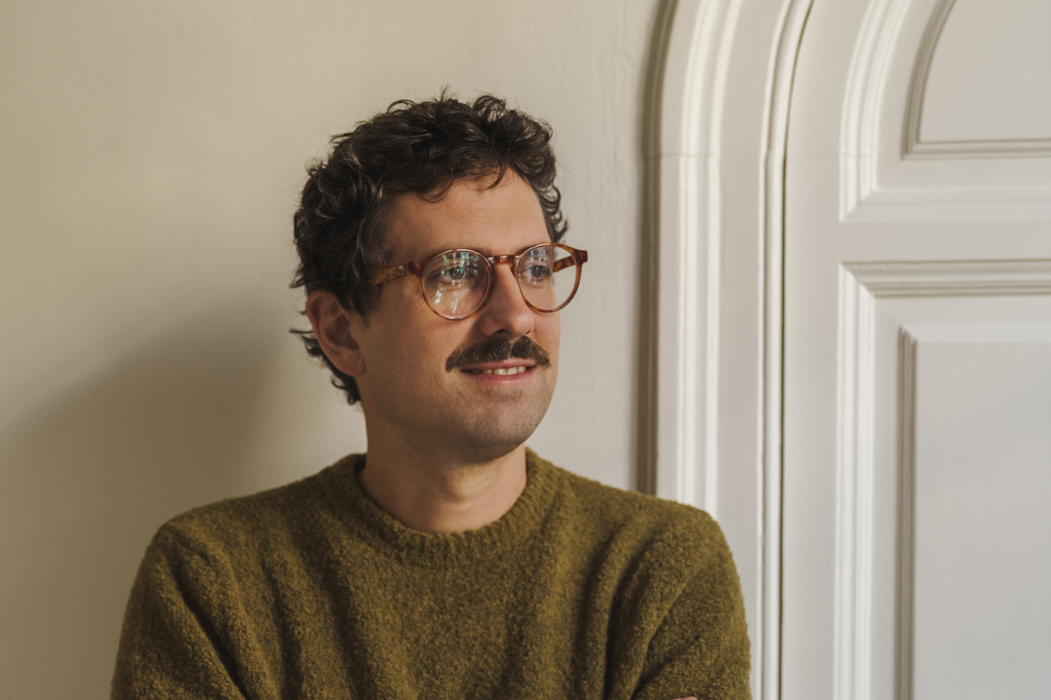
Ricard Grau is an architect at the cooperative Laboqueria Arquitectura and a member of the association Repoblem. His practice connects architecture, rural life and the collective management of resources, with a perspective rooted in small villages and in the forms of coexistence that sustain everyday life in low-density territories.
As part of Girbau LAB’s Neighbourhood Interview Series, this conversation focuses on how shared services -such as laundry, shared production kitchens, care spaces and other community infrastructures- can strengthen neighbourhood ties, help retain population and respond to challenges such as water scarcity, isolation and the lack of basic services.
Talking with Ricard means understanding that life in small villages is not a static reality, but an ecosystem that continually finds new strategies for coexistence. Through his experience, he explores the shift from the self-sufficiency of traditional rural houses towards a new rurality where shared services become essential neighbourhood infrastructures.
In this conversation, he argues that living in a small village is a constant exercise in care and interdependence, where shared laundry is not only an efficient solution to water scarcity, but also a meeting space that recovers the social role of the old communal washhouses. He also invites us to look at the future through a form of social innovation that connects the knowledge of older residents with the needs of newcomers, turning mutual support into a tool to combat isolation and guarantee dignity in rural life.
Listen the original interview
One of the reasons we’ve invited you is to bring this perspective of spaces in rural areas. What would you say are the general challenges facing villages or “micropobles” today?
From my own experience as a newcomer to a tiny village in central Catalonia, I see villages that have suffered from an exponential demographic exodus for many years. The modernization of agricultural machinery and the centralization of services have led many aging residents to move to larger municipalities or cities for certain comforts.
What do we find now? People who want to change their daily lives, take on a life challenge, and live in harmony with nature, but we find ourselves in desolate villages with very limited services, where transport and communication are almost non-existent.
So, currently, these municipalities must overcome these challenges with a different focus: a focus on health and on creating a new community where the values of coexistence are at the forefront to tackle daily challenges.
In fact, we’ve been talking a lot during this series about the dimension of coexistence and the relationship between neighbors. What differences do you see? I understand you used to live in a more urban environment. What differences do you notice in daily life and neighborly relations?
That’s a very interesting reflection. I was thinking about it on my way here. I have lived in a city like São Paulo, with 11 million inhabitants, where many of the buildings I lived in had no shared services or community spaces, despite so many people living in the same building. Then I moved to the Born district in the center of Barcelona, in a relatively small building where one of the common spaces -the terrace- was privatized, so we didn’t have a very deep neighborly relationship.
Then I moved to a village where there are only 14 of us, in the middle of Segarra, and the neighborhood community is truly one of “care.” We always say that living in a village like ours is a matter of “getting through a winter.” And getting through a winter means emotional care, taking care of basic needs, and shared coexistence.
So, for me, it has been a radical change; even though you are in a tiny village where you might feel lonely, you are actually very much accompanied.
Regarding scale and the number of people around you, how has the domestic scale evolved? In Catalonia, homes have generally become smaller. In the context of “micropobles,” which scale makes more sense for domestic practices: the house, the village, the neighborhood, or the county?
I am part of the association Repoblem, where we analyze many cases across different regions of Catalonia. One of the most interesting points we discuss is that a century ago, people in these villages lived in fairly self-sufficient homes based on constant production.
In those houses, there was no “sofa area” or a place to watch TV. The heart of the home was the kitchen, the core for the family, and the community spaces were the public laundries (safarejos). These two spaces—one private, one communal—defined where people met, talked, and shared the day’s concerns. They were crucial for the social and emotional well-being of these villages.
For example, in the Vall del Corb where we live, there are over 12 cataloged laundries and water basins that municipalities are now restoring. They are being restored because they are icons of a time when the whole community met to wash clothes and share life experiences. It was a relationship deeply rooted in water.
With climate change, these laundries have lost their water supply, but they are now used for cultural tours or meeting points for hikers. Meanwhile, houses have changed. Kitchens used to be the largest space because of the hearth and the benches to keep warm in winter. Now, television has taken over, conversation has become one-way, and these communal meeting points have dissolved.
So the dynamic has moved from the outside in. Now I’d like to focus on the image of laundry. What is the reality of doing laundry in rural villages today? Do you see a difference compared to urban settings?
Well, there is a crucial point I mentioned earlier: the laundry space fulfills a basic need for clean, dry clothes, especially when you have children or elderly people in your care.
We are seeing industrial laundry services appearing in nearby towns like Cervera or Tàrrega. Why? Because of the rise of rural tourism. A rural house might host 6 to 21 people in a single weekend; because of the high turnover, they use industrial services. This has created jobs and social economy enterprises.
Parallel to this, in the houses I am renovating as an architect, the laundry room is no longer in the center of the house but is part of the exterior. If the house has a garden, we build an annex for the laundry. Why? Because we live in an environment with a lot of wind and fog, and very few hours of sun in winter. We need large spaces to use dryers privately.
At Repoblem, we’ve seen that in villages with newcomers from the city, the community is asking for shared spaces for specific activities: a communal BBQ area because many houses have small gardens; a space for childcare after school; and a third space for laundry (washing, drying, and ironing) not just for private homes, but also for local businesses or cultural activities.
Water was key in ancestral practices. What resources are most important when planning these services today?
We talk a lot with town councils. The main challenge between 2024 and 2030 is water management. Some villages have two types of water: from aquifers and from canals.
Water management is precious. Until now, because there was plenty, farmers had a tap and water flowed without worry. Now, we must invest in repairing old pipes because they lose massive amounts of water.
This makes us look back at the past. The house where I lived for six years had two cisterns. Water was stored based on the seasons to ensure it stayed clean. We are starting to implement this again: installing cisterns of at least 10,000 liters. Last year it didn’t rain for eight months. People are realizing that what used to be seen as free now requires community management.
Which spaces have the most impact on this collective management? Besides laundry, are there others?
Yes. Agricultural activity is concentrating into fewer hands, and intensive livestock farming consumes huge amounts of water, which creates conflicts with other services.
Another factor is that people were running out of water at home because they hadn’t maintained their cisterns. We’ve had cases in the Pyrenees where they had to hire water trucks. And what were the main consumptions? Showers and laundry. This made people reflect: can we shower in 5 minutes instead of 20? Can we reuse clothes instead of washing them every day?
Dryers are also interesting. When you dry clothes, you see the micro-residue (fibers) in the filter. In some villages, they’ve bought shared industrial dryers, and seeing the amount of waste has sparked debates about the impact of our consumption. It’s the same debate as solar energy: panels in the fields or on the roofs? Productive activity must be conscious of its impact on the people living nearby.
It’s very interesting to look at daily practices. I’d like to explore the dimension of “sharing.” People seem to be losing the cultural skill of living in a community, yet in villages, this culture of mutual support seems to persist. How would you describe it?
It’s because many villages are still second homes for people born there. This identity means that organizing the local festival or a tradition like the Castanyada is in their blood. Two neighbors might hate each other, but on the day of the festival, everyone is in the square helping out. It’s a respect for culture that sits above personal conflicts.
As a newcomer, I see that conversation is slow. You have to build bonds and understand dynamics with respect. We are still in a “romantic” moment where people share rights of way, tools, or—if it snows—a farmer takes his tractor and clears the paths for everyone without being asked. It’s in their DNA.
Also, old town halls are being transformed into “service houses” where people meet and share food, toys, or sound equipment. It happens naturally; no one had to impose it.
What other spaces facilitate this socialization?
For farmers, the scales where they weigh their tractors are a key spot to talk about the weather or the harvest. In larger villages, the bar is the nerve center. There are also BBQs, playgrounds, and cooperatives.
Cooperatives were born to control the production of oil, wine, or grain. Some are thriving, others are fading due to a lack of young people taking over. Some are very innovative, like the one in L’Espluga de Francolí, which even has a gym. It’s a shame many people don’t see the potential of these collective spaces.
To finish, what is the “shadow” side of rural life? What makes a shared service actually successful and consolidated in a village?
The reality in Catalonia is that there are lacks in transport, healthcare, and housing. In some areas, everything is focused on tourism, leaving no housing for locals. In central Catalonia, roads are a major limitation, and fiber-optic internet only arrived last year.
Town councils have very limited resources. You have to be very strategic: when you shop, you shop for two weeks. If you miss an appointment, you might not see a doctor again for another 15 days.
The interesting part is when these communities coexist: the farmer and the newcomer who doesn’t work in agriculture. When it rains, the town hall becomes a hub where some do improvise co-working, kids play, and the elderly eat or socialize. These spaces are strategic because everyone takes care of them. We are also seeing “care centers” for the elderly that aren’t traditional nursing homes, but places to meet—and these spaces could also host shared laundries.
Looking ahead, how do you think laundry or other shared services will evolve in small villages?
One concern is that we are losing traditional trades: the blacksmith, the carpenter, the stonemason. We are losing the master-apprentice relationship and the wisdom of the elderly.
There is a break in this community knowledge, but interesting solutions are appearing, like mobile service vans bringing bread, meat, or cleaning services to villages with no shops. Shared production kitchens (obradors) are also growing. I think applying this to health and cleaning services would be very interesting.
Many elderly people will leave the villages if they don’t have these services. Sharing care and services is a tool to keep the population in place and educate both the young and the old in a dynamic of collaboration that, in fact, has always existed.
Thank you very much for joining us at Neighbourhood Interview Series. You’ve touched on many fascinating topics.
Thank you for inviting me.
share