

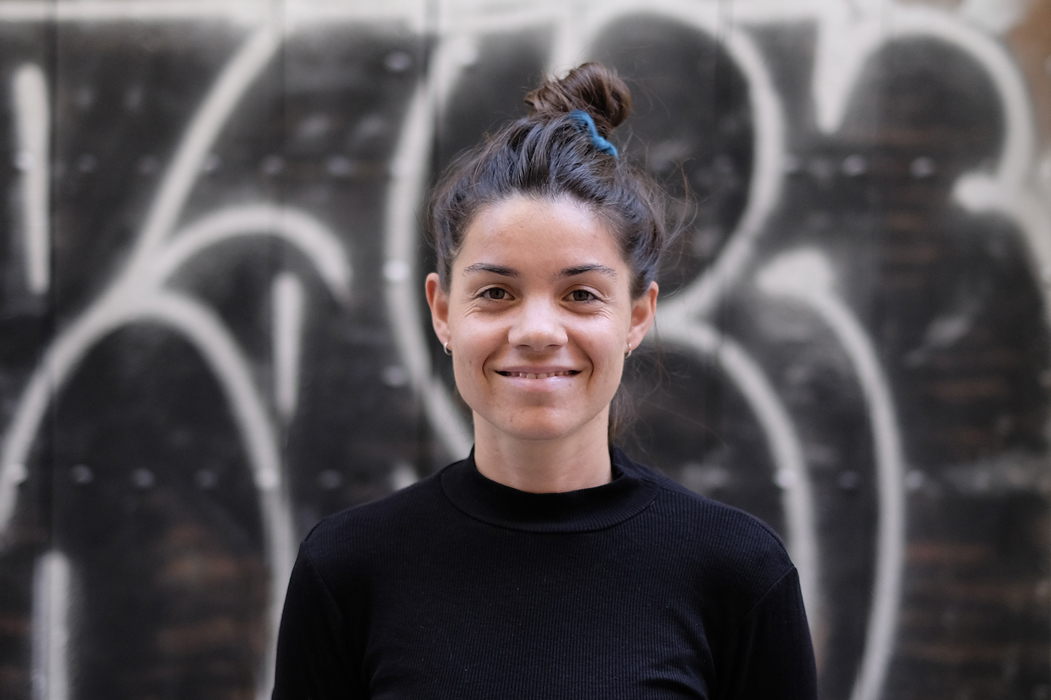
In this conversation, Cristina Gamboa, a member of the Lacol architects’ cooperative, shares her reflections on the transformative role of shared services in cooperative housing in Catalonia, highlighting the community laundry as a strategic and indispensable space. Far from being understood as dark or peripheral places, these spaces are conceived as central and well-lit areas within the building, promoting neighbourliness, energy efficiency and resource savings in a context of climate emergency. Through examples such as La Borda, La Balma or La Morada, she explains how sharing services for domestic tasks allows us to rethink gradients of privacy and coexistence, while expanding current regulatory interpretations of habitability to move towards more regenerative architectural models.
Listen the original interview
In the process of social change towards economic, community-based and sustainable practices in the domestic sphere, such as those explored by Neighbourhood Interview Series, architects play a central role. Furthermore, at Lacol you specialize in cooperative housing projects where shared spaces are an important element. From your experience, what role do shared services play in housing projects in Catalonia today?
For us, it is one of the key aspects. Rethinking how we live, what the gradients of privacy are, and how everyday activities can be shared within community spaces is what allows us to rethink these dynamics. It also allows us to reconsider the environmental impacts of our activities, including laundry.
Furthermore, the laundry is a space that everyone will use, because it is a necessary daily activity. It differs from other activities, such as cooking together, which people may choose to do or not. This makes it both fundamental and full of potential.
In this sense, from our experience, we consider that the ability to introduce community spaces is one of the most distinctive aspects of the model. It breaks with more established logics and with the everyday dynamics of families. Being able to work on the programme allows us to understand how we want to live together.
Each community is different, but we observe that activities such as washing clothes, cooking, caring for children or older people, or sharing objects all have an impact on coexistence and on the kind of society we want to project. It also helps us understand how community spaces have not only a social impact, but also an environmental one.
In a context of climate emergency and resource scarcity, having experienced droughts and exceptional situations such as Covid, these spaces allow us to reduce demand and rethink the protocols we establish at home, understanding home as the building itself, which is profoundly transformative.
What would you say are the most common shared services in the projects you develop in Catalonia today? And what role does the laundry play? Is it a more central or more peripheral service?
Well, each community, as we work with it, defines in some way what the programme is and which community spaces the building needs, closely aligned with the model of coexistence they imagine. Therefore, some communities are more intentional, with a stronger desire to live together, while others may feel more hesitant at first or find it harder to imagine, and leave things more open.
However, those activities that are part of everyone’s daily life tend to be present in shared services. The laundry is a very important service, it is indispensable and present in all projects. A shared kitchen or a multipurpose meeting space is also always included.
Naturally, energy production systems and installations, both for domestic hot water and heating, are also part of these shared services. Finally, shared storage spaces often appear to allow for the sharing of objects, and in many cases, there are guest rooms, spaces where one might say: “instead of having an empty room for a friend who visits once every three months, we share it.”
In this sense, as I mentioned, the laundry is essential. It is a deliberate choice because we believe it is a key space for interaction, since everyone needs to wash their clothes every week. At the same time, it allows for more efficient systems and helps us reflect on energy and water demand, among other aspects.
Regarding your role, or that of your colleagues at Lacol, when designing these spaces and services… what conditions help make everyday use easy, natural, and almost unnoticeable for users? At what stage is it most important to get this right in the project?
At the moment when we are defining the building’s program, the set of spaces that make it up, that is really the origin; it is the starting point. The next step, of course, is how we position and articulate these spaces.
We talk a lot about this public-private transition: from the public space to these shared spaces, the entrance, the communal areas, until reaching the more private parts. I think the collective imagination of the laundry room is often linked to films, to patterns from other Northern European countries, where the laundry is located in dark basement spaces, unseen areas that stem from this logic of hiding everything related to reproductive work. Also, the washing machine is placed in this less privileged location, and I think the idea is to turn this around.
We do not have a perfect solution; we are currently considering whether the laundry should be closer to the roof to be near the drying area. But often, since it is a point that generates encounters and unexpected relationships, we prefer to place it in a more strategic location. For example, in the La Borda project, the laundry room is on the first floor, next to the multipurpose space, and allows you to see your neighbours and the entrance from a central point.
I believe that the position of the laundry has a strategic role, and the way we design it, well lit, connected to the terrace, spacious, turns it into a place to stay.
What would you say is the difference between simply installing machines and designing a good laundry service? What are its key ingredients?
Well, up to now we have designed four laundry rooms, and they are quite different. There is the issue of location, size and lighting conditions, but also how the space can be open or closed. Obviously, the laundry will have moments of spinning and noise.
So, I believe in the capacity of this space to be permeable, bright and open. There is also all the storage and equipment: baskets for moving clothes, we could imagine having a couple of shared ones instead of everyone bringing their own, cleaning tools, detergents, whether shared or individual. Also ironing, whether the space allows you to fold clothes, iron them or store them temporarily. The size, equipment and installations, hot water, cold water, or even recycled greywater, are essential.
What are the main mistakes when designing the service? Not only the spaces, but also the everyday user experience.
I think that what might be considered a mistake in one project works perfectly well in another. For example, the washing process is closely linked to booking systems and the number of machines. There is an initial learning phase where there is a lot of hesitation about moving from an individual to a collective washing machine.
Understanding how many units are needed and what booking systems are established is key. In the case of La Borda, there is an app that works very well and allows 28 units to share two professional machines and one domestic one for specific situations. In contrast, at La Balma, machines are not booked and it works very well for them, they do not want to change. So, for now, it is difficult for us to define what is right or wrong, because each community has different dynamics.
Beyond each community’s dynamics, have you observed general patterns regarding economic impact, water use or broader systemic reflections of general interest?
I cannot give you specific data, but it is clear that collectivising them is already a starting point for reducing consumption impact. We do not have 28 individual washing machines, so we are reducing both equipment and their connections to the network.
Moreover, collectivization allows us to use more efficient machines that reduce electricity and water demand. These are better machines, with shorter cycles, and they can be supplied by the collective hot water system. It is well established that this significantly reduces environmental impact. We have also seen that maintenance of professional machines is very simple.
What would you say are the main tensions? Probably between efficiency and comfort? What dilemmas have you encountered?
On the one hand, family dynamics are diverse. The decision not to install individual washing machines can clash with personal situations were moving around the building becomes difficult, for example, a parent caring for a child.
From a regulatory perspective, we are required to prepare each dwelling for an individual washing machine. So, given people’s concerns, the starting point is usually: “we install shared ones, and if there is a problem, there is always the option of an individual one.” In reality, in many cooperatives I do not know anyone who has actually installed one.
There are also tensions around use: using greywater for washing, when we know it is treated and safe, using dyes or very delicate wool garments. All this requires establishing usage protocols and reaching agreements.
To what extent does the perception of time change when laundry stops being a strictly private activity? Does it become a different kind of moment in daily life?
My partner, who usually does the laundry, has the feeling that it becomes a longer activity precisely because you go to the room, meet someone, talk, it creates a whole range of possibilities in between. At the same time, if you have a good machine, the washing cycle is very short and you get it done quickly.
In La Borda, going down to the second floor becomes a rewarding personal experience of interaction. And then there is the act of hanging clothes on the roof, with views over the city, sun and air, it becomes a moment to take a breath and chat while hanging sheets. Collectivizing this cycle generates a whole set of situations and constellations that I find wonderful.
What impact does shared laundry have on how we understand neighbourliness?
Honestly, in these spaces we are not so far from what my grandmother used to do when she went to the village washhouse; it was a space for interaction with its own protocols, the day for dark clothes, etc. We have tended to isolate ourselves, and now we are returning to this activity that creates bonds with neighbours.
It is interesting and beautiful to look at the data and notice differences, a single person doing as many loads as a household of four. It makes us reflect on how we live, our self-demand and how we can optimize water use. Sharing data openly allows us to build community through acceptance of diversity.
In La Morada, for example, they are very aware of inclusion and sensitivity to chemicals. This has led to community protocols: they have two washing spaces, ground floor and roof, and in one of them they use products suitable for people with chemical sensitivities. Being aware of how we can accommodate new practices is what the laundry cycle teaches us.
If you think 20 or 30 years ahead, what role do you see for shared knowledge and architecture?
I would like to think that having a shared laundry in buildings will become much more widespread and recognized, and that regulations will be more flexible and will no longer require space for washing inside each dwelling. It could become an infrastructural element of the building, like hot water production.
Urban-scale infrastructures linked to clothing exchange could also emerge. The future lies in being much more efficient, reusing building water for washing and controlling the chemicals we use so they can be reintegrated into ecosystems.
What limits or barriers exist to scaling this model and making it more common?
There is a strong cultural component: we tend to avoid conflict and the dialogue needed to reach agreements. For more collective services to exist, community management must be strengthened. More than building, we need to learn how to manage what we already have.
We need operational mechanisms that facilitate use: data management to fairly distribute costs, simple machines with clear instructions, and roles that help activate and support communities. These practical aspects ultimately determine the success of the system.
In terms of regulation, the habitability decree needs to become more adaptable. Pilot projects are exemplary mechanisms to push for these changes. IMPSOL, for example, is an exceptional case of public housing that is rethinking these “infrastructures of wellbeing.”
Finally, we are in the year of Barcelona as the World Capital of Architecture. What capacity does architecture have to generate positive social, environmental and economic impact and foster a regenerative approach?
We have a great responsibility. We must reduce the environmental impact of materials, rethink whether we need to build new or rehabilitate, and improve how buildings are used and managed. In renovation projects, we can restructure systems to close water cycles. Everyday practices and small-scale needs are the key to the transformations that must come.
share