

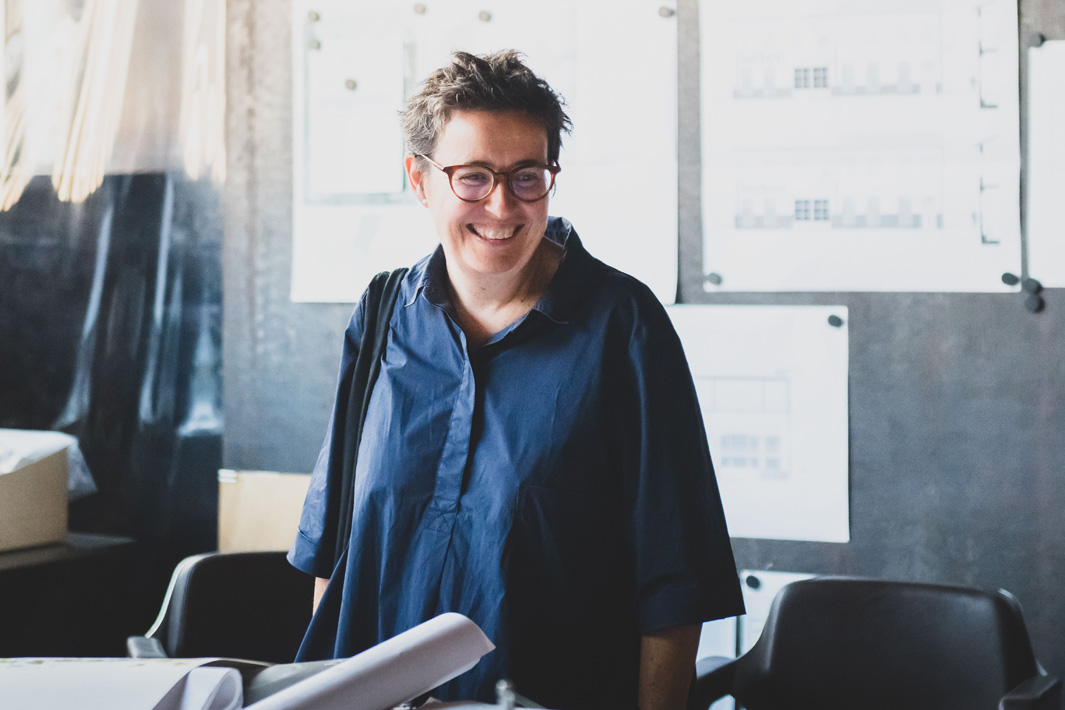
Talking with Maria means moving between the micro and the macro scales of the city. An urban architect and currently the Chief Architect of the Barcelona City Council, in this conversation Maria discusses how the city creates, or hinders, the conditions that structure the lives of its residents: from urban planning and the programming of public facilities to the way meeting spaces such as parks, public transport, libraries and civic centres are developed.
She argues that cities are, by definition, open and heterogeneous, and that the challenge is to live together without naïveté: understanding neighbourhood not as “feel-good” goodwill or forced friendship, but as an everyday form of coexistence.
She also explores the relationship between neighbourhoods at the city scale and the neighbourliness among people who share a stairwell or building, with whom you might share services such as doing the laundry, and how both create a form of extended neighbourhood, or a continuum of neighbourliness, that is key to living in the city.
Finally, she frames this small-scale neighbourliness as a lever for change in addressing more structural problems, such as growing loneliness, not only among older people, or cultural tensions arising from fear of difference.
Listen the original interview
At Neighbourhood Interview Series we are opening conversations about more sustainable, economic and community ways of living, and inevitably we end up talking about housing. Political, social and media debates usually focus above all on the housing emergency and the difficulties of accessing and maintaining housing. But today we would like to leave urgency aside and focus on other dimensions of habitability and its challenges. What do you perceive affects people’s day-to-day lives in their homes or in the city?
The first thing to say is that we should recognize that we have a heterogeneous society, much more so than in previous times. Urban crises are not so new: there have been housing crises before. Perhaps the newest is the climate crisis. And inequalities have also always accompanied us. Perhaps what is poignant now is that we believed we had already left them behind and they are reappearing.
If we are aware of this heterogeneity, one thing that becomes evident is that when we express problems in generic concepts, then we need to introduce nuance: because these problems do not affect or have the same impact depending on the people in front of you. And this, in the definition of public policies and also in the big headlines, must be kept in mind.
We have a population that is aging and, at the same time, a part of the population that is very lonely. There are life models that, while the family existed, were very good, but when there are members who disappear, this unwanted loneliness generates a double impact: aging is added and family circumstances change.
And then there are the conditions of cities. Cities, by definition, have a newly arrived population. They are always open. What usually catches my attention is a scene, let’s say normal, on the bus. I am very observant; I look at the world around me a lot. And I am impressed to see how a person who comes from another country has a need to connect to the place of arrival, but also to maintain a bond with someone who is eight or ten thousand kilometres away. On public transport you see people with their lives grounded here, but with an antenna placed in a conversation with a relative in another time zone. And in such an uncertain world, when you open the newspaper and there are days when you say “I don’t know where we’re going”, I think one of our tasks is to think about how to bring hope, how to bring a future, if people come to cities to find opportunities, to build this future. I think all of this is on the table.
You mentioned loneliness, and it is also a central theme of our conversation at Neighbourhood. Barcelona is a very compact city, but there is a growing loneliness that not only affects the elderly, but also young people or single-parent families. How do you interpret this paradox? And what is being done, or what needs to be done, to address it?
Barcelona is compact, yes. And you could say: it doesn’t make sense that we all live so close together and that there is unwanted loneliness. But we need to put different realities on the table: there are countries where people go to cities to disappear, to not be found. Here, due to culture and the way things are done, the city has given rise to neighbourhood buildings where you more or less knew who the neighbour upstairs was or the lady next door. And this has been partially lost, although it cannot be generalized: it depends on the areas, it depends on the moments, it depends on the fabric of the neighbourhoods.
However, we also have infrastructures that support these important social ties. Local markets, for example, have a very important social function: from Monday to Friday there are elderly people who go shopping and have half an hour of conversation. We have parks, civic centres. The city, from a public policy perspective, has historically made an effort to generate facilities and meeting spaces. The library program, the strategic plans, all of this has a significant impact.
And at the same time there is another element that may be scary: the pandemic has highlighted loneliness at different ages. It is also good to bring up the discussion about social networks. I am not saying this as an architect, I am also saying this as a mother. The capacity for isolation that these devices produce… before we watched TV as a family or with neighbours, because someone had a TV and the rest did not. There were discussions, you had to choose. Today everyone can watch what they want when they want and where they want. And with all this there is a contradiction: apparent overexposure that should overcome loneliness, but at the same time a condition of individual encapsulation.
From the point of view of architecture and local administration, our job is to generate scenarios so that life happens. I do not define life, I generate conditions. And I love it when life surprises me. For example, seeing young people dancing and doing choreography in spaces that were not “programmed” for this using the big window-like mirrors. Things like these appear in small places and spread. So, I think sometimes we have to dedicate ourselves more to observing and seeing what happens.
This look at the relationship between everyday practices and the city is very interesting. Laundry is perhaps also an example of a daily practice that has been changing with the city. From washing to public laundries to the washing machine at home, or now with self-service laundries. What role do you think the administration can have in observing, promoting or facilitating shared practices in the city?
Here is an idea that interests me a lot, which is the so-called social innovations. There is always the discussion of whether they come from outside or from within the established framework. I visualize it as a membrane. Activism from the outside will tighten the seams of the status quo, and that is perfect. But those of us who are inside can also push the membrane from the inside to see how flexible it is. I love testing how far you can stretch it. I think it is the sum of both.
And if you allow me to criticize some apparently sustainable contemporary positions: I am an advocate of pedestrians and public transport because it is the same response with respect to the collective. Being sustainable in the city today, I believe, is not having a little house with your garden, your bread and your plate. I believe that individual solutions will not be sustainable. If we have any possibility, they will be collective solutions.
That is why I find this conversation about rethinking community spaces such as shared laundry interesting. What is the point of each person having a machine plugged into their home, individual, that you use a few times a week, and that also takes up a small amount of space? But what interests me most about all this is a key issue, which is civility. Promoting a sense of community in buildings and living in a city is also a scale of civility. We don’t have to be friends. We have to be able to coexist.
If the spaces we design generate situations where this is put into practice, you are training tolerance and respect. Not a condescending tolerance, but a conscious one. And perhaps we would save ourselves a lot of extremisms if we saw that at the end of the day the human species is quite similar all over the world. And yes: everyone washes their dirty clothes, because nobody likes to get dirty. People don’t get dirty by choice.
And when we talk about these shared practices in the building, what are the real levers for a city council to create favorable conditions?
First of all, I have to say that I don’t work alone. The role of ‘Chief Architect’ is very broad, and sometimes people ask “what do you do?”. It’s not an ivory tower. A city council has planning tools, and with planning you can promote things. There is also the dimension of public housing, and that of equipment programming.
An example that we now have on the table is a plan for public toilets. We are not talking about public laundries, but we are talking about this move from individual to shared solutions that give dignity and make life easier. And then, when we design public space, we create meeting spaces. We have large parks, but also “pocket parks” that have a closer domesticity. You see five or six people, elderly people, who come out into the sun, with chairs, and spend some time. This look is important. And I go back to what I was saying: without being condescending. Living together in a city is not about establishing bonds of forced friendship. It is human dignity. I get on the bus and say good morning. I see that person every day. It is a recognition: I see you, I do you a service, I greet you. And that builds a city.
We have been talking about the concept of neighbourliness, which is one of the topics that we are exploring in the Series Neighbourhood. For you, what does good neighbourliness mean in Barcelona? And what conditions can the city generate to promote it?
As I said, the city is a heterogeneous space and that is neither good nor bad. It is a condition. And faced with a heterogeneous reality you have two options: either subdivide and specialize spaces, or make them as accessible as possible so that it is life, this heterogeneity, that gives them colour, always on the premise of coexistence. No use can take up the other 100%. This has happened throughout the history of cities, here and elsewhere. So, good neighbourliness, for me, has to do with something inherent to the human condition: overcoming the fear of the unknown and of difference. We must provide spaces and conditions that demonstrate that this difference is, to a large extent, artificial. Kids also show it: they play with anything that is there, and it is indifferent to the kid in front of them whether it speaks the same language or not. There is a universal language. And you have to accept that your neighbours do not have to be the same as you. In a city, neighbourliness is the recognition of a space where we can live together in democracy and freedom. There is cohabitation and an effort, or curiosity, to know the other. Not prejudice. Because we all have problems, and there are good and bad people in every house, and at the end of the day human concerns are shared. I believe that we have done this way of understanding neighbourhoods in the past, we must do it in the present and we will have to continue doing it in the future.
That said, there is a neighbourhood that interests me less, and it is the one that generates walls. Sometimes people understand “everydayness” as “comfort” and I think that is a mistake. Good neighbourhoods are tested on the subway, on the bus, on the street. The subway takes you from one place to another. And precisely for this reason, when we think about the city, we cannot do it only from the daily comfort of my closest environment. Let us let ourselves be carried away and discover. In places where you have never been, you will surely discover that your neighbour has a public space of similar quality. The blocks are different, yes, but it is not an a priori assumption. There are interesting things in any corner of the city. So, I think that neighbourhoods cannot be an excuse to close yourself off. On the contrary: a good neighbourhood is in the whole space where you move. And it is very interesting to see how neighbourhoods can be discontinuous. If you make a child draw the map of the city they have in their head, they can put the grandparents’ house very close even if it is at the other end. Because it is a map of nodes and networks. I would like people to have this neighbourhood in their heads: there is no hierarchy of “my neighbourhood” as a limit. It is an attitude of living in the city.
And how do you connect this city neighbourhood with the neighbourhood of the building and the close scale, where you can have shared services, for example? Can it be training for a wider neighbourhood?
Totally. When you share spaces and daily practices, you are training a form of coexistence. And I insist: there is no need for over-niceness or forced friendship. Living together is recognizing the other, learning to manage friction, practicing civility. It is a learning process.
The neighbourhood of our staircase, the one of the buildings, can be a lever so that later, when you leave, you are not surprised by difference. Because you already have practice in the effort of coexistence. And this is also important for structural problems such as loneliness, cultural tensions resulting from fear, the feeling that the world is uncertain and so on. When you have spaces where life happens, you also have opportunities to make visible that “difference” is not a threat by default.
To finish, let’s look to the future. How do you imagine the evolution of shared practices between neighbours in Barcelona?
Regarding the future, I have a friend who taught me a phrase: that the future is written in the present. The population of the future has already been born; it is already here. And it would be good not to spoil it too much.
I am optimistic, because otherwise I would not dedicate myself to what I dedicate myself to. And I also believe that we can always improve, or more than anything adapts. And we have to think that a generation will grow up that no longer has the same way of rooting itself in the city as previous generations. This is interesting: there will be a more proactive part of each person to look for what kind of neighbourhood they need at each stage of life.
The frenzy of a big city is not the same as an intermediate city with services. And in our country, we have services everywhere. We are at distances where health, educational, cultural and recreational services can be ensured. The pandemic, for example, demonstrated the importance of adapting. So, I imagine a future where these community practices will be generated more, and where the concept of neighbourhood will be more dynamic, with the ability to understand itself as a continuum between territories and less limited ways of looking.
Photo: Ceci Firmia
share