

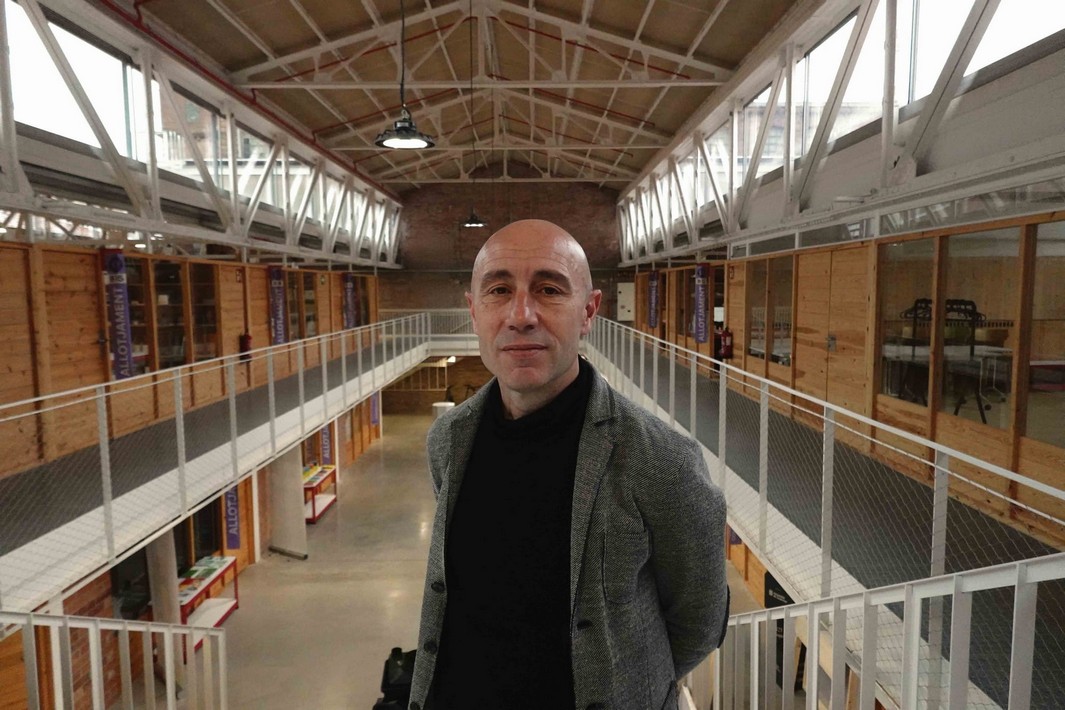
Talking to Josep Maria is talking about housing beyond housing. An architect by training and technical manager at IMPSOL, his perspective places housing as a long-term social infrastructure, capable of accommodating changing ways of life, shared daily practices and an idea of community that cannot be taken for granted. In this interview, Josep Maria reflects on the regulatory, cultural and economic limits of innovation in public housing, on the pedagogical role of the administration and on specific experiences such as shared laundries, community spaces or flexible and non-hierarchical housing models.
The dialogue places special emphasis on the need to think about housing with a long horizon, assuming that the buildings that are built today will have to continue to function in fifty or a hundred years, in a social, demographic and cultural context that we cannot fully foresee.
Listen the original interview
To begin, I would like to put ourselves in a general perspective. When we talk about innovations in housing models, both public and private, what would you say are the major changes that are taking place today?
I think we are clearly in a moment of paradigm shift. I wouldn’t know if this change began before or after the pandemic, but there is a deep questioning of the big issues. We all carry a backpack of our life’s learning: the way we have lived, how we have been taught to live, the models that we have inherited.
In my personal case, for example, today as I was saying I live with a partner and we have our own washing machine at home, with very conscious use, especially in terms of energy consumption, and with natural drying. But I have also gone through stages in which I have used shared neighborhood laundries, those where you put coins, because I didn’t have a washing machine or because I had moved apartments. All of this is part of our daily experience.
From this experience, what we understand is that housing should not only respond to a strictly residential need. Housing is a habitable social infrastructure, a facility where people live. And when you assume this starting point, you realize that, as society evolves, so do forms of coexistence, family structures, collective needs.
The traditional nuclear family is no longer the only model, nor probably the majority, and this forces us to rethink everything. We continue to carry beliefs and learnings, but there comes a time when we must ask ourselves if these models still respond to what we need today and, above all, what we will need tomorrow.
And how is this perspective translated into the practice of a public developer like IMPSOL?
In our case, this leads us to try to learn from many different models. We learn from the cooperative model, we learn from the private sector, we learn from what other countries do. We try to keep an open and updated perspective, not only on what people are asking for today, but on what we understand that society will need in the future.
Here there is an important difference between what is asked for and what is needed. We are a public entity, non-profit, with a clearly public interest. This forces us to think in terms of collective need. And from this position, we believe that society needs non-hierarchical housing, flexible housing, communities with shared spaces, integrated facilities, and also relearning to share.
We try to reflect all of this in the specifications of the competitions we promote. It is not a question of the architects who present themselves reproducing my ideas or those of IMPSOL, but rather we want to generate a flexible enough framework so that the teams can propose innovative ideas. We are interested in receiving proposals from the local, regional, state or international community of architects. This diversity of perspectives is key.
In concrete terms, we work a lot with non-hierarchical, flexible, inclusive, expandable housing. Housing that can be more atomized or more concentrated depending on the case, but that above all incorporate the idea of sharing. That the inhabitants understand that housing does not begin or end with the door of the apartment, but that the building is part of this habitat, as an intermediate space between the public and the private.
This commitment to new models that you are making certainly has limits. What are, in your opinion, the main limits that you encounter?
The limits are diverse. One of the clearest is the regulatory limit. There have been important changes, such as decree 50/2020, which allows community spaces to be calculated within the calculation of the surface area of housing. For us, this change has been key.
It must be taken into account that we are a public entity but we operate, in many aspects, like a private developer. We do not receive monetary contributions ordinary and we must be self-sufficient. Before 2020, when we built a community room, for example a shared laundry, this was almost a gift that the administration gave to the community, but economically it greatly penalized the viability of the promotion.
With the regulatory change, we can attribute part of these community spaces to the homes. This opens the door to working in a different way. But the limits are not only regulatory. There are also cultural, political, social limits.
We work with the general citizen, not only with people already convinced of cooperative or community models. Our audience is very broad, and this implies constant pedagogical work. We have to find the right point: sufficiently advanced models, but ones that are socially acceptable and accepted. If we build buildings that are too advanced that then remain empty because there is no demand, that is a failure. And if we invest public money in community spaces that are not used, it is also a failure.
How do you manage this tension between innovation and social acceptance?
The key is to understand that the buildings we build are social infrastructures that will last a hundred or a hundred and fifty years. We know how we live today, but we don’t know how we will live in ten, twenty or fifty years. Therefore, we must design buildings that respond to current needs but are capable of adapting.
Added to this is economic viability. Everything we implement must have a monetary and social return. We must be able to demonstrate to future town councils that certain initiatives, such as community laundries, work. That is why we produce, monitor and analyse results. This database and experience is what allows us to continue investing in these models.
Going into more detail, how do you structure the coexistence models when you propose a building?
IMPSOL acts as a technical service for town councils. We do not have our own land. We work based on agreements: a city council makes a plot of land available to us and gives us a specific assignment. It can be a building for the elderly, for young people, intergenerational, or a project that needs to generate income through homes for sale with permanent qualification.
The tenure regime influences the program and the coexistence model. Rental housing, for example, allows more flexibility. But, in general, we believe that the most inclusive model is one that mixes different regimes within the same building. This allows a certain social stability, with more established neighbors and others with more rotation, but maintaining a shared identity.
Our standard home is a non-hierarchical home, with rooms of a minimum of twelve square meters, up to three bedrooms, open kitchen, outdoor space and community spaces that encourage socialization. Always with a very clear view towards environmental sustainability and towards the industrialization of construction processes.
One of the specific experiences you have promoted is the shared laundry. What is your assessment of it?
We started this model based on the rehabilitation of an office building converted into subsidized housing. We decided that it was a line that we had to bet on. Today, in all the buildings that we promote, there is, at least, provision for a shared laundry space.
The buildings will last a hundred or a hundred and fifty years. Maybe at the initial moment there is not enough demand, but we are convinced that it will grow. In many European countries this is normal. Here we have a very strong cultural component.
We also see that the shared laundry is a question of economic and energy efficiency. We cannot ask groups with few resources to buy an individual washing machine, with the initial cost and associated consumption. Our model involves guaranteeing the space, encouraging its use, making it pleasant and not imposing it. That is why these shared spaces that we reserve are not residual. They have natural light, contact with the outside, space to dry, to iron, to sit. They are spaces for socializing.
And how do you manage the costs of these shared services?
Well, we have tried many models. With coins, making it a predefined option, etc. But I would say that the model that is being consolidated is one in which the costs fall only on the users who use the service. Each laundromat has its own water and electricity meters, and the expense is shared between the users. This avoids friction. If everyone had to pay for a service that they do not use, the model would not work.
At the same time, when you divide the use of a domestic washing machine between several neighbors, the efficiency is very high. And when demand grows, you can make the leap to more industrial systems, since they often start with domestic washing machines.
Finally, how do you see the future of these housing and coexistence models?
We are experiencing a housing crisis, a construction sector crisis and a precariation of the profession of architects. Regarding my profession, I see a task to continue redefining the role of the architect, who must also be a dynamizer of change processes. At the same time, I also see buildings with more shared spaces. And this is where the figure of the mediator that we are beginning to pilot will be key. The key will be to design these spaces so that they are flexible and adaptable over time.
share